Is It Time To Replace Your Gas Boiler … With An Air Source Heat pump?
Understanding the Key Differences Between Gas Boilers and Air Source Heat Pumps
Where do we start with this?
The key difference between a gas boiler and an air source heat pump is; heat pumps are much more efficient than gas boilers.
The efficiency of a boiler is the amount of power you need compared to the units of heat you get out.
Modern gas boilers are usually just over 90% efficient, so for every unit of gas you use (1 kWh) you’ll get 0.9 kW of heat generated.
Air source heat pumps use air to create heat, which is free, so they only use electricity to power fans and compressors.
This makes air source heat pumps between 300 and 400% efficient, meaning for every unit of electricity (kWh) you use, you’ll get between 3 and 4 kW of heat.
So, the price of running the two types of 'heaters' works out around the same as gas is 3 times cheaper than electricity.
The big advantage gas boilers have is they are instantaneous, as soon as you switch them on they quickly start to heat your home.
Air source heat pumps take a while to get your home up to heat, but they are designed to keep it that way all the time.
How Air Source Heat Pumps Actually Work
We have covered this in depth in other blogs, you’ll find a good one here, but here’s a quick, simple explanation.
Air source heat pumps work by extracting heat from the air outside your home and using it to heat water in specially designed hot water cylinders.
'How does that work?' I hear you say!
Sounds like magic but, like most things that sound magic, it’s actually simple physics.
Air is passed over a refrigerant with a very low heating point, this raises the temperature of the liquid a little.
The liquid is then put under extreme pressure, pushing the molecules together and increasing the temperature significantly.
This super-heated refrigerant is then used to heat water in the specially designed tank.
From that point, the system works like a normal central heating system.
Signs Your Gas Boiler May Be Ready for Replacement
Odd smells
This could be very serious indeed as it could be a gas leak. As boilers get older, their parts start to wear out.
So, a gas leak could be a broken seal, a cracked pipe or faulty valve.
Turn it off and call a Gas Safe engineer!
Always stopping
A lot of boilers have safety features that will shut the whole unit down if something isn’t right.
A lot of the time this can be due to low water pressure in the system, a break in the electricity supply or a lack of ventilation because someone blocked the vent.
These things are usually easy sorted by following the manufacturer’s instructions to fix the fault.
However, if the boiler is failing quite regularly, like a few times a week, it could be something more serious and you may need a new one.
You gas bill is creeping up
This one can actually be quite hard to catch.
Bills fluctuate so much with the price of oil, the time of year and demand that your bill we different every month.
You could also be on a fixed tariff, so you won’t notice until you have to make up the difference and the end of your contract.
However, if you are partial to keeping an eye on your smart meter, you may notice your gas boiler getting less efficient.
This is when you need to investigate and see if the parts in your boiler are starting to wear out.
Yellow Flame
This could be very serious, so if you notice the flame is yellow in your boiler, please turn it off and contact a Gas Safe engineer.
It means that there’s a problem with the gas or emissions.
Water leakage
This is probably the most obvious problem you’ll see.
Much like the gas smell, this will be caused by a pipe problem, a seal going or a valve breaking.
It could be a simple fix but, if you boiler is a decade old, it’s a sign of the parts starting to wear out.
The Environmental Benefits of Switching to a Heat Pump
Unlike solar, an air source heat pump isn’t going to save you a fortune on your bills.
They will save you money in the long run, but it’s not an immediate saving like a solar energy system.
So, a lot of people switch to heat pumps for environment reasons.
The environmental benefits are pretty obvious to be honest, basically you’re not burning huge amounts of fossil fuels to create heat.
Granted, you still need electricity to make them work, but as the UK grid gets greener, that is less of a problem.
Plus, a lot of people pair air source heat pumps with solar or wind energy systems - meaning there is almost no environmental impact.
Installation Requirements and What to Expect
If you are changing your old combi-boiler for an air source heat pump, there will a few things you will need to consider.
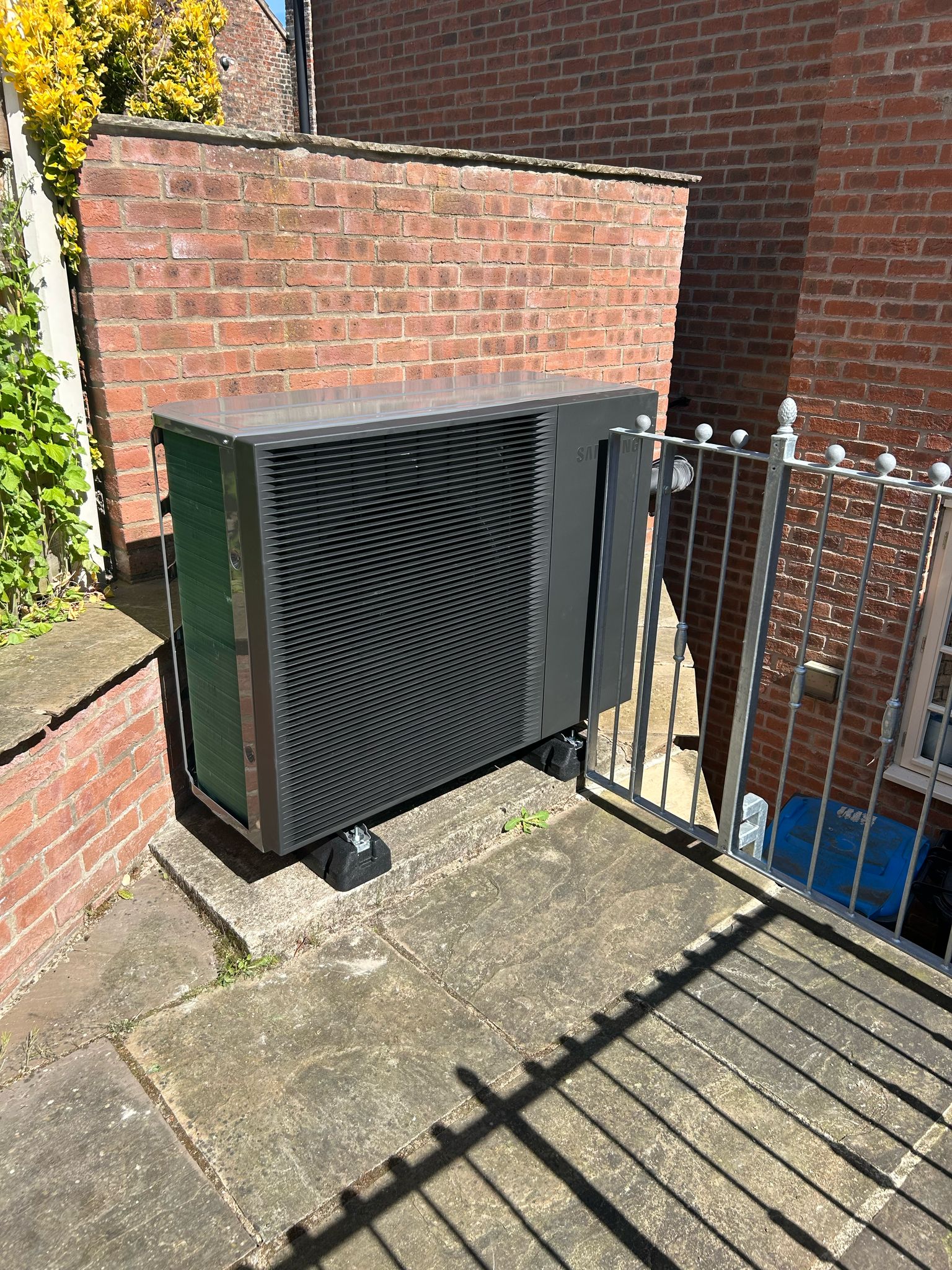
The actual air source heat pump will be situated outside your home, so you need to make sure you have space for a large box – about 2 metres wide, by a metre deep and a metre and a half high.
It needs to have plenty of airflow round it too, so you shouldn’t box it in or surround it with foliage.
Inside the home you will need space for the water cylinder.
These will vary in size, but they are usually a metre and half high and take up the same space as an average fridge/freezer.
You will need a survey before anyone starts to work on your home, to ensure your insulation and windows are suitable for a heat pump.
This is because the pump is designed to keep your home at a constant heat, so you don't want any of that heat escaping.
You may also need to replace a few radiators. This is because air source heat pumps work at a lower temperature than gas boilers so you may need a larger surface area on your radiators to make sure they heat the room correctly.
Government Incentives
The BUS is the biggie!
This is the government’s Boiler Upgrade Scheme grant and it’s available to most homeowners in the UK.
You’ll get a whopping £7500 towards an air source heat pump so long as you are replacing an old fossil fuel boiler.
There are various other grants available through local councils and eco schemes, but they vary from postcode to postcode.